


Public spending is rising, but investment priorities are shifting. What does this mean for businesses and property investors?
November 05, 2026
Public spending is rising, but investment priorities are shifting. What does this mean for businesses and property investors?
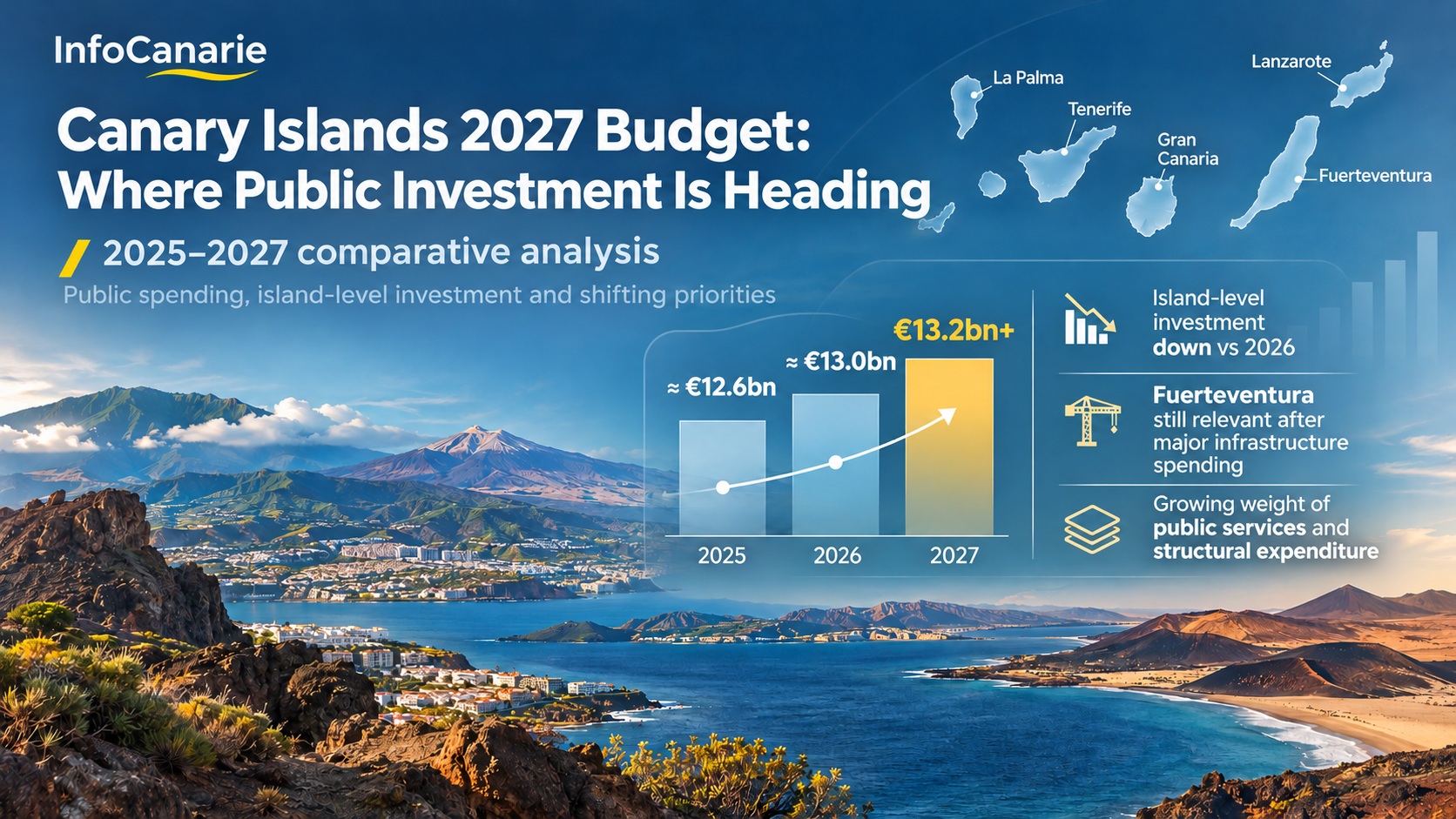
The Canary Islands' proposed 2027 budget reaches €13.2 billion, up 5.7% from 2026. Yet geographically allocated public investment is set to decline across much of the archipelago.
The apparent contradiction reflects a change in spending priorities rather than a straightforward reduction in public expenditure.
Why 2026 Was an Exceptional Year
In 2026, public investment allocated to individual islands reached €281.9 million in Tenerife, €271.5 million in Gran Canaria, €144.7 million in Lanzarote, €139.9 million in Fuerteventura and €129.5 million in La Palma.
These allocations reflected an unusually intensive investment cycle, supported by European recovery funding and major infrastructure programmes.
Consequently, 2026 should not automatically be considered a normal benchmark for future spending.
Different Islands, Different Investment Dynamics
Fuerteventura provides a particularly relevant example. Investment increased from €119.7 million in 2025 to €139.9 million in 2026, before declining to a proposed €110.2 million in 2027.
This adjustment follows a period of major infrastructure commitments, including the Aeropuerto–Pozo Negro road project, valued at more than €215 million.
Tenerife and Gran Canaria show more moderate reductions, with proposed 2027 allocations of €261.7 million and €249.2 million respectively.
La Palma follows a different trajectory, influenced by extraordinary reconstruction funding after the Tajogaite volcanic eruption, including €50 million allocated in both 2024 and 2025.
These differences illustrate why annual investment figures must be interpreted within each island's broader economic and infrastructure cycle.
The Real Shift in the 2027 Budget
While geographically allocated investment declines, the overall regional budget continues to expand.
Healthcare, education, social services, justice, security and housing receive approximately €970 million in additional funding. Excluding the effect of European recovery funds, these areas account for around 83.3% of regional expenditure.
The proposed budget therefore points towards a greater concentration of resources on public services and structural commitments.
The Canary Islands are not necessarily spending less. They are spending differently.
What Matters for Investors?
For businesses and property investors, public spending figures are only one part of the investment landscape.
Infrastructure development, territorial connectivity, economic activity and the continuity of public investment programmes all influence the environment in which property markets evolve.
Fuerteventura remains particularly relevant following its recent infrastructure investment cycle, while Tenerife and Gran Canaria display comparatively steadier public allocation patterns.
The key is not simply which island receives more funding, but how public investment contributes to its long-term economic environment.
InfoCanarie Real Estate will continue monitoring the approval process of the 2027 budget and the evolution of public investment across the Canary Islands.
Main Sources: Gobierno de Canarias – Proposed General Budget 2027; 2026 Budget and territorial investment allocations; Parlamento de Canarias – Budget documentation; Gobierno de Canarias – Fuerteventura road infrastructure and La Palma reconstruction programmes.
By "InfoCanarie" - InfoCanarie Promotion and Consulting
Since 1999, InfoCanarie has been supporting entrepreneurs, investors and families in real estate investment, business internationalization, company setup and the development of economic activities in the Canary Islands.
 |
 |
Questo indirizzo email è protetto dagli spambots. È necessario abilitare JavaScript per vederlo. |  |
GO TO THE SUMMARY INDEX FOR ALL INVESTMENT INSIGHTS IN THE CANARY ISLANDS